
Cleaning Space-Bound Hardware
The Genesis collector canister was cleaned and assembled in two ISO Class 4 vertical flow cleanrooms. (A Class 4 cleanroom allows no airborne particulates greater than 0.5 µm and a maximum of 352 particles of this size per cubic meter of air.) One of the clean rooms was a “wet” lab used for cleaning spacecraft parts with ultrapure water (UPW). UPW, which has ionic concentrations in the low parts per trillion level, is a very aggressive solvent. A small plant furnishes 10 gallons per minute of pure water with a resistivity exceeding 18 MΩ.
The second clean room was used for assembling the payload—NASA’s cleanest assembly room. Since people are the dirtiest part of a cleanroom operation, scientists assembling the payload were completely enclosed in Gore-Tex® suits equipped with a filter that removes particles > 0.3 µm from exhaled breath. A clean room corridor is adjacent to the cleanrooms rooms and allows viewing of the cleaning and assembly process. Other rooms in the facility are for personnel gowning, sample storage, and removing outer wrappings from in–bound objects.
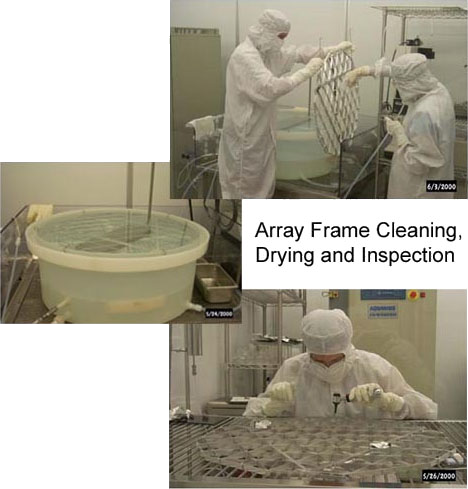
Photographs showing the process of array frame cleaning, drying and inspection
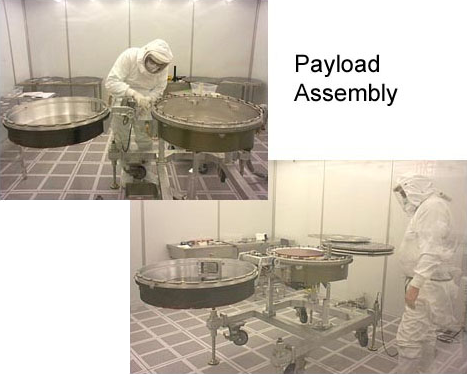
Photographs showing the assembly of the array frames into the payload body
Cleaning Genesis Sample Return Canister for Flight: Lessons for Planetary Sample Return