
Stardust: Dust from Comets and Interstellar Space
Stardust, a NASA Discovery-class mission, was the first to return samples from a comet and from interstellar space. The mission launched on February 7, 1999 and successfully encountered comet Wild-2 on January 2, 2004. As the spacecraft passed through the comet’s coma, a tray of silica aerogel was opened and exposed to capture coma dust grains. Following the collection, the aerogel tray was closed, for return to Earth. The Stardust sample return capsule then cruised back to Earth, and landed early in the morning on January 15, 2006 at the Utah Test & Training Range (UTTR) in western Utah. Once on the ground, the sample return capsule was placed into a dry nitrogen environment and flown to the Stardust Laboratory at JSC.
Based on the data returned from the comet encounter and preliminary examination of the Stardust Cometary aerogel, we believe that we captured thousands of grains from Comet Wild-2.
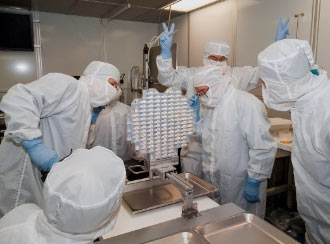
Scientists examine the aerogel tray after its arrival at JSC.
In addition to sampling the comet, Stardust opened another aerogel tray and exposed it to open space during the cruise phase of the mission. Based on data from dust detectors aboard the Ulysses and Galileo spacecraft revealing that there is a stream of interstellar dust flowing through our solar system, the Stardust team anticipated that the Interstellar aerogel tray would be able to collect approximately 100 grains of fresh interstellar dust transiting through our solar system.