
The NASA Cosmic Dust Collections
The NASA Astromaterials Acquisition and Curation Office cares for collections of materials from across the Solar System, and as part of that suite of astromaterials the Cosmic Dust Collections curates the small material which naturally falls to Earth. Cosmic dust includes interplanetary dust particles (IDPs) which are particles from comets, asteroids, and other bodies that are generally smaller than 0.1mm in diameter. IDPs are small enough and decelerate quickly enough when falling into Earth's atmosphere that their heating from atmospheric drag may be limited. Slightly larger particles tend to completely melt, but may survive their high-speed entry into the atmosphere and fall to Earth as micrometeorites. IDPs and micrometeorites are collectively known as “cosmic dust“, and even though these particles are tiny they make up the majority of the mass of astromaterials which fall to Earth each year.
The Cosmic Dust Collections are comprised of both IDPs and micrometeorites (MMs) (Figure 1). The collections also include terrestrial dust, aluminum oxide spheres produced by solid rocket motors, terrestrial biological debris such as pollen grains, and other tiny particles. The NASA Cosmic Dust Collections have been active since 1981 and include over 11,000 individual particles as well as whole collectors and archived collection hardware. The collections currently include the Aircraft Collected Particle (ACP) collection of IDPs collected using high-altitude aircraft and micrometeorites collected from the South Pole Water Well (SPWW). NASA continues to collect new Cosmic Dust samples with high-altitude aircraft and Advanced Curation efforts are underway to expand collection strategies to include high-altitude balloons and other methods. To date, over 500 scientific papers and meeting abstracts have been produced from this effort, describing the scientific community's ongoing efforts to understand our Solar System through these tiny grains.
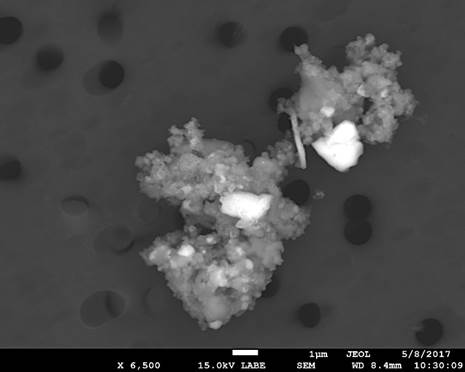
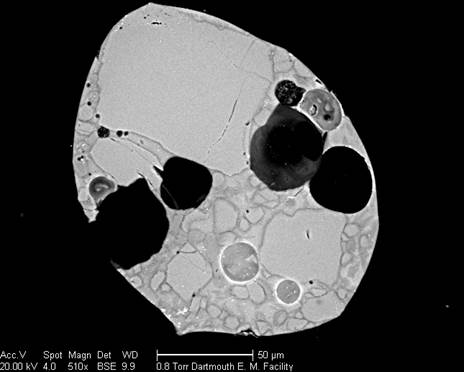
Figure 1: An interplanetary dust particle (IDP) from the Aircraft Collected Particle (ACP) collection. This cosmic dust is fine-grained, contains carbon, primitive silicates and sulfides, and is small – the scale bar at bottom center is 1 micrometer long. The second image is the polished face of a micrometeorite from the South Pole Water Well (SPWW) micrometeorite collection showing silicate grains and vesicles (the black spheroids). This micrometeorite is rounded from passage through the Earth's atmosphere and is approximately 180 micrometers across. Notice the size difference between the two images – the micrometeorite is approximately 70x the size of the IDP.
NASA maintains the Cosmic Dust Collections to provide carefully collected cosmic dust to scientists around the world for research purposes. Samples may be requested for scientific research any time throughout the year by contacting the Curator with a written request. Details on how to select samples and submit the request are available HERE. Contact the Curator with questions or assistance in placing a request.